Why Longer Exhales Calm You Down, and the Ratio That Actually Works
Quick Answer: Longer exhales work because heart rate physically slows during exhalation via vagal activity — an effect called respiratory sinus arrhythmia. A ratio of roughly 1:2, such as inhale 4 and exhale 8, at about 5 to 6 breaths per minute produces the strongest measurable effect for most people.
Someone told you to breathe out longer than you breathe in, and it worked, and you have no idea why.
There is a real mechanism, it is well characterised, and knowing it makes the practice considerably more useful.
There is also a specific ratio that works better than the others.
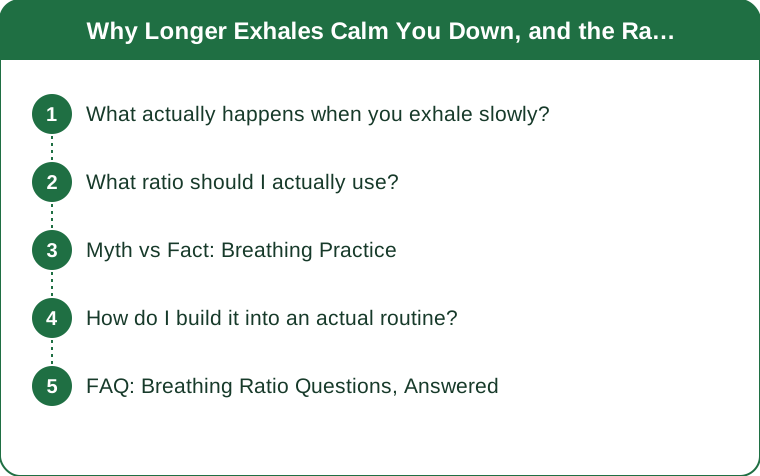
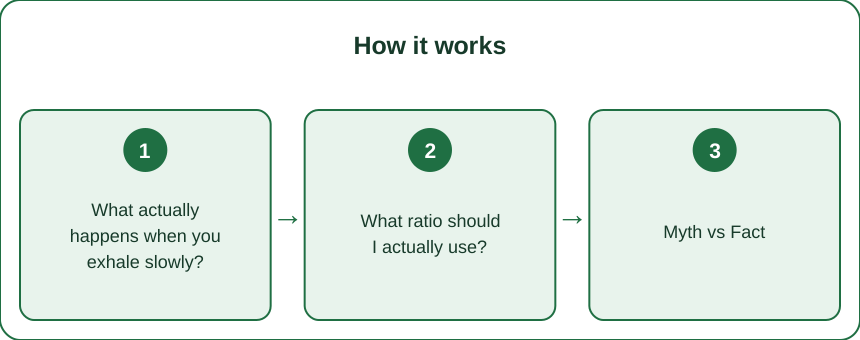
What actually happens when you exhale slowly?
Your heart rate changes with your breath, every breath, whether you notice it or not.
During inhalation, vagal outflow to the heart is briefly inhibited and heart rate rises. During exhalation, vagal activity resumes and heart rate falls. This oscillation is called respiratory sinus arrhythmia, and it is a normal, healthy feature of cardiac function — a bigger swing generally indicates better autonomic flexibility.
Extending the exhale extends the phase in which the vagus nerve is dominant. Longer exhale, longer stretch of parasympathetic activity per breath cycle, lower average heart rate.
There is a second mechanism at the baroreceptors — pressure sensors in the carotid arteries and aortic arch. Slow breathing at around 6 breaths per minute creates blood pressure oscillations that synchronise with the breathing cycle, and that resonance amplifies the baroreflex response considerably. This is why breathing rate matters independently of the inhale-exhale ratio.
So you have two levers: the ratio, and the overall rate. The strongest effects come from using both.
What ratio should I actually use?
Start at 1:2, and adjust the absolute numbers to fit your capacity rather than forcing a fixed count.
Inhale 4, exhale 8 is the standard version and works well for most people. That is 12 seconds per breath, giving 5 breaths per minute — comfortably inside the resonance range.
Inhale 3, exhale 6 for anyone who finds 4 and 8 strained. Same ratio, 10-second cycle, 6 breaths per minute. Still in the effective band.
Inhale 5, exhale 10 if 4 and 8 feels easy. 4 breaths per minute, which is slower than the resonance optimum for most but produces a strong effect for those who tolerate it.
The critical instruction: the exhale should be relaxed and unforced. Squeezing air out at the end creates tension in the abdomen and neck, which activates exactly the system you are trying to quiet. If the last two counts feel like effort, your numbers are too high.
There is a common variant with a hold after the inhale. It is fine, but the hold is not what is doing the work — the exhale is. Skip it if it makes the practice harder to sustain.

Myth vs Fact: Breathing Practice
Myth: You need to breathe into your belly for it to work. Fact: Diaphragmatic breathing is efficient and comfortable, but the vagal effect comes from the exhale duration and the breathing rate, not from where the movement is visible. Chasing belly movement often creates more tension than it resolves.
Myth: More is better — longer sessions produce better results. Fact: The acute effect appears within 2 to 5 minutes. Longer sessions build the skill and may improve baseline autonomic tone over weeks, but a 3-minute practice does most of the immediate work.
Myth: Breathwork works instantly in a panic state. Fact: This is the most important correction. In an active panic response, slow breathing is genuinely difficult and attempting it can increase distress. The practice works best as a preventive daily habit and in early or mild activation — not as an emergency brake once the response is fully underway.
Myth: Nasal breathing is essential. Fact: Nasal breathing is preferable — it adds resistance which naturally slows the breath, and it humidifies air. But an exhale through pursed lips is a perfectly valid and sometimes easier way to lengthen the exhale.
Myth: If it makes you dizzy you are doing it right. Fact: Dizziness means you are moving too much air — over-breathing rather than slow breathing. Reduce the depth, keep the rate.
How do I build it into an actual routine?
Small, anchored to something you already do, and daily.
The 3-minute daily practice. Same time each day, anchored to an existing habit — after brushing your teeth, before opening your laptop. Inhale 4, exhale 8, for 3 minutes. That is 15 breaths. This is the version that builds baseline change over weeks.
The transition practice. Six breaths in the car before going inside, or between meetings. Not enough to change your day, but enough to interrupt a carry-over of tension from one thing to the next.
The pre-sleep practice. Lying down, 5 minutes of inhale 4 exhale 8. This is where most people notice the effect first and most clearly, because sleep onset is sensitive to autonomic state.
What to expect on a timeline: an immediate but modest effect from session one. A clearer sense of it working somewhere in week two. Changes in resting heart rate variability, if you track it, over 6 to 8 weeks of consistent practice.
The failure mode is treating it as a tool you reach for only when stressed. It works far better as a small daily thing that happens whether you need it or not.
FAQ: Breathing Ratio Questions, Answered
What if I cannot get to an 8-count exhale?
Use 3 and 6, or even 2 and 4. The ratio matters more than the absolute numbers, and forcing a longer count than you can do comfortably works against the purpose.
Can I do this while walking?
Yes, and matching the breath to your steps works well — four steps in, eight steps out. It is one of the easier ways to build the habit.
Is it safe if I have a respiratory or heart condition?
Slow breathing at a comfortable depth is generally well tolerated, but anyone with a significant respiratory or cardiac condition should check with their doctor first. This is general information, not medical advice.
TL;DR:
- Longer exhales work through respiratory sinus arrhythmia — heart rate genuinely falls during exhalation via vagal activity.
- Use a 1:2 ratio at 5 to 6 breaths per minute: inhale 4, exhale 8, or 3 and 6 if that is more comfortable.
- The exhale must be relaxed, not forced — effort at the end defeats the purpose.
- It is a daily preventive practice, not an emergency tool for full panic.
Three minutes, once a day, anchored to something you already do. That is the whole prescription, and it is one of the very few interventions in this space where the mechanism is well understood and the dose is genuinely small. This is general information, not medical advice.
Keep Reading
This article is for general informational purposes only and is not medical advice. Always consult a qualified health professional for guidance specific to you.