Breathing Techniques for the Dentist and Medical Procedures
Quick Answer: In a dental chair you cannot breathe through your mouth, cannot change position, and cannot pause. That rules out most breathwork. What works is nasal-only breathing with a long exhale — inhale for a count of four through the nose, exhale for six to eight, with no breath holds. Set the pattern before the procedure begins, and use a physical anchor such as pressing your heels down, because counting alone fails once you are anxious.
Someone tells you to take a deep breath. You take a big chest breath, your heart rate goes up, and now you feel worse and there is equipment in your mouth.
That is not a failure of nerve. Big deep breaths are genuinely the wrong tool here, and there is a better one.

Why does taking a deep breath backfire?
Because a large fast inhale is an arousal signal, not a calming one.
Your heart rate rises on the inhale and falls on the exhale. That is respiratory sinus arrhythmia, and it is normal. The consequence is that inhale-dominant breathing raises arousal and exhale-dominant breathing lowers it. Someone telling you to take a deep breath is instructing you to do the half that increases activation.
There is a second problem. Rapid deep breathing lowers blood carbon dioxide, and low CO2 causes lightheadedness, tingling in the hands and face, and a sense of unreality — which people in an already anxious situation reliably interpret as an emergency. That interpretation drives faster breathing, and the loop closes.
The fix is not to breathe more. It is to breathe slower on the way out, keep the volume normal, and avoid holds entirely. Breath holds are common in breathwork and they are a poor choice here, because the urge to breathe at the end of a hold is exactly the sensation you do not want in a chair you cannot get out of.
What is the actual pattern to use?
A simple, unglamorous one, and the constraints of the setting choose it for you.
The pattern: inhale 4 through the nose, exhale 6 to 8 through the nose. No pause at either end.
Why each part:
- Nasal only, because your mouth will be occupied and because nasal breathing is slower and adds resistance, which naturally lengthens the breath
- Exhale longer than inhale, because that is the half that lowers arousal
- No holds, because air hunger in a confined setting is destabilising
- Normal volume, not deep — you are changing the rhythm, not the size
If a count of six on the exhale feels like a strain, use five. Straining to hit a number is itself activating, and the ratio matters more than the specific figures.
Aim for roughly five to six breaths per minute. That is much slower than normal resting breathing and it is the rate at which the calming effect is most consistent.
How do you set it up before the procedure?
This is the part people skip and it is what makes the difference between the technique working and evaporating.
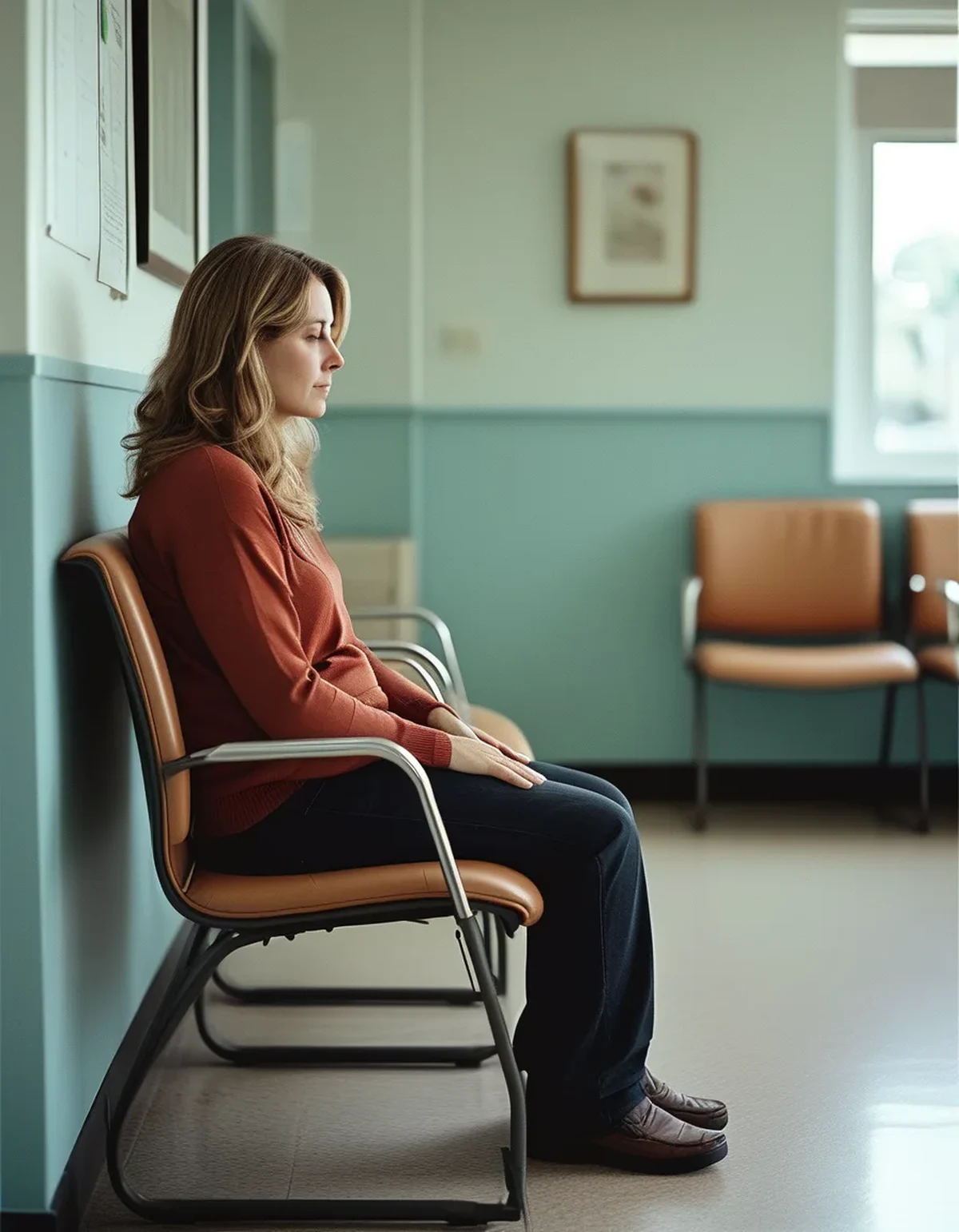
In the waiting room — three minutes. Run the pattern before you are anxious. You are establishing a rhythm your body can fall back into, not learning it under pressure.
Tell the clinician. Say that you get anxious, that you will be breathing slowly through your nose, and agree a hand signal for stop. Knowing you can pause is a large part of the effect, and the signal usually gets used far less often than people expect.
Pick a physical anchor. Counting fails once anxiety rises because working memory degrades. Instead, tie the breath to something you can feel: press your heels into the footrest on the exhale and release on the inhale. Or press one thumb into the opposite palm. The physical anchor is more robust than a number.
Set a visual focus. One fixed point on the ceiling. Eyes open and fixed is generally better than closed here, because closed eyes make many people more aware of sensation, not less.
Practise for a week beforehand if the appointment is a big one. Two minutes a day is enough to make the pattern familiar, and familiarity is most of what you are buying.
What Nobody Tells You About Breathing Through a Procedure
Your nose will probably block. Anxiety, lying back, and a warm room all contribute. Practise the pattern lying flat at home so you find this out in advance rather than in the chair. If one nostril is blocked, breathing through one nostril is fine — it is slower, which is the direction you want anyway.
Swallowing gets complicated. With instruments in your mouth, the reflex to swallow becomes a source of panic for many people. Suction handles it; the anticipation is worse than the reality. Agreeing the hand signal covers this too.
Slow breathing makes time feel longer, and some people find that unhelpful. If you are one of them, pair the breathing with a podcast or music through headphones — most dental practices are happy with this, and the combination works better than either alone.
You will lose the pattern. Everyone does, several times. The skill is not maintaining it perfectly; it is noticing and restarting, without treating the lapse as a failure. Expect three or four restarts in a long appointment and it becomes a non-event.
It works better with local anaesthetic, not instead of it. Breathing manages the anxiety response; it does not manage pain. If you are anxious about pain specifically, that is a conversation to have with the clinician about anaesthesia, not something to breathe through.
What about the day of, and afterwards?
A few things that make the whole thing easier and are unrelated to technique.
Before: eat something. Low blood sugar makes anxiety symptoms substantially worse and they are easy to confuse. Go easy on caffeine — it raises baseline heart rate and it is the one variable entirely within your control. Book a morning appointment if you can, so you are not spending a day anticipating it.
During: it is fine to ask for breaks at intervals rather than only when you are struggling. Agreeing in advance to a pause every ten minutes is far more comfortable than having to signal distress to get one.
Afterwards: the adrenaline takes a while to clear and many people feel shaky for an hour. That is a normal comedown, not a sign anything went wrong. A short walk helps more than sitting still.
For next time: note what worked while it is fresh. People who get through one appointment with a working technique find the next one substantially easier, and dental anxiety in particular responds well to a sequence of successful experiences.
This is general information, not medical advice. If anxiety about dental or medical procedures is severe enough that you avoid necessary care, that is worth raising with your doctor or dentist — sedation options and referral for anxiety treatment both exist and both work.
FAQ: Breathing Through Procedures Questions, Answered
Can I use 4-7-8 breathing instead?
Not ideally in this setting. The seven-count hold creates air hunger, and air hunger in a chair you cannot leave tends to increase panic rather than reduce it. Keep the long exhale, drop the hold.
What if I am a mouth breather and nasal breathing is hard?
Practise it in advance in low-stakes settings, and mention it to the clinician — they can plan for periods where your mouth is free. A blocked nose on the day is worth mentioning too, since it changes how the appointment is run.
Does this work for injections and blood draws?
Yes, and there it is easier because your mouth is available. The same ratio applies. One addition for blood draws specifically: if you have a history of fainting, tell them, because the technique for that involves briefly tensing muscles rather than relaxing.
What about a physiological sigh?
A double inhale followed by a long exhale works well and is quick. It is a good option in the waiting room and between stages of a procedure, less practical continuously.
How long before it starts to work?
Most people notice a change within 60 to 90 seconds of holding the rhythm. If nothing has shifted after three minutes, check that the exhale is genuinely longer than the inhale — that is nearly always the part that has slipped.
TL;DR:
- A big deep breath increases arousal — the exhale is the calming half
- Use nasal inhale 4, nasal exhale 6 to 8, no holds, at about five to six breaths per minute
- Establish the pattern in the waiting room, not in the chair
- Use a physical anchor — heels pressed on the exhale — because counting fails under stress
- Agree a hand signal for stop; knowing you can pause does much of the work
- Expect to lose the rhythm several times; restarting is the skill
None of this requires you to be calm to begin with. It requires one ratio, one anchor, and the understanding that losing it and picking it up again is what using it actually looks like.
Keep Reading
This article is for general informational purposes only and is not medical advice. Always consult a qualified health professional for guidance specific to you.