How to Use Breathwork Before a Presentation Without Making It Worse
Quick Answer: Use extended exhales - any pattern where the out-breath is longer than the in-breath - for roughly two minutes, ideally 90 seconds before you start rather than twenty minutes before. Slow, controlled nasal breathing with a longer exhale has the best support for shifting autonomic balance quickly. What does not work well under real performance stress is deep breathing without an exhale emphasis, which frequently increases lightheadedness and makes people feel worse.
Somebody told you to take deep breaths and it made your hands shake more. That advice was half right, and the missing half is the part that does the work.

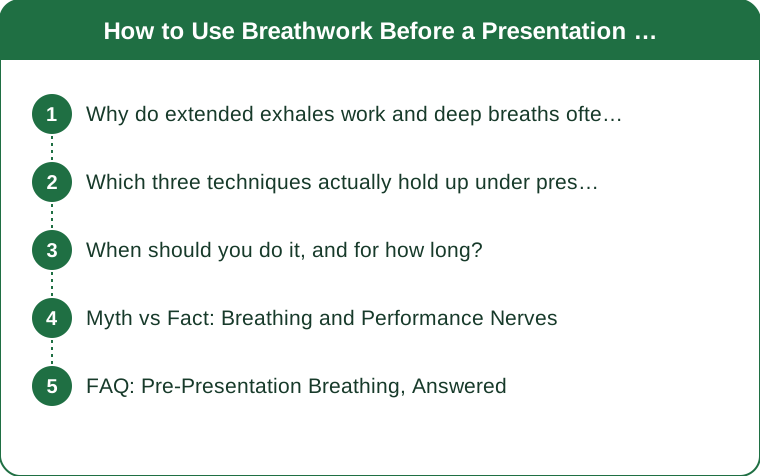
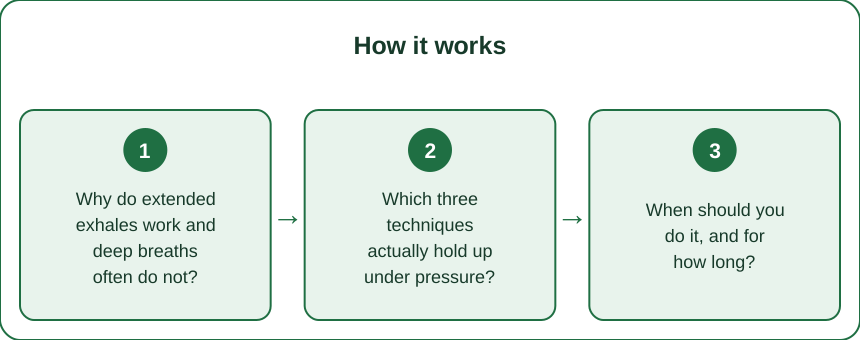
Why do extended exhales work and deep breaths often do not?
Heart rate is modulated by the breath cycle - it rises slightly on inhalation and falls on exhalation. Lengthening the exhale relative to the inhale therefore biases the cycle toward the parasympathetic side, and this is a well-established physiological relationship rather than a wellness claim.
Slow breathing around six breaths per minute has the strongest evidence base for increasing heart rate variability and shifting autonomic balance. That is roughly a four-second inhale and a six-second exhale, and it is achievable by almost anyone without practice.
Deep breathing without exhale emphasis frequently backfires. Instructions to take big deep breaths often produce over-breathing, which lowers carbon dioxide levels and can cause lightheadedness, tingling, and a subjective increase in anxiety - the exact opposite of what was intended.
Under adrenaline, breathing is already fast and shallow, and the useful correction is slowing rather than deepening. The instinct to breathe bigger addresses the wrong variable, since the problem is rate and pattern, not volume.
And nasal breathing matters more than it sounds. Breathing through the nose naturally limits the volume per breath, which makes over-breathing much harder to do accidentally, and it slows the whole cycle without conscious effort.
Which three techniques actually hold up under pressure?
One: the 4-6, done for two minutes. Inhale through the nose for four counts, exhale through the nose or slightly pursed lips for six. No holds, no complexity. This is the default and it works for the large majority of people.
Two: the physiological sigh, for the ninety seconds immediately before you start. Two inhales through the nose - a full one followed by a short additional sip at the top - then a long slow exhale through the mouth. Three to five repetitions. It is fast, it is discreet, and it works when you have almost no time.
Three: box breathing at a modest count, for the longer wait. Four in, four hold, four out, four hold. The holds make it more engaging, which helps when you have ten minutes of waiting and a mind that keeps returning to what could go wrong. Keep the count low - long holds under adrenaline are unpleasant and unnecessary.
The one to avoid before performance: rapid or forceful breathing techniques. Wim Hof style breathing, breath of fire, and similar hyperventilation-based practices produce a strong sympathetic activation and can cause dizziness or fainting. They have their place; ninety seconds before you speak is not it.
And do not hold your breath while waiting, which is what most people do by default. Breath-holding under stress is extremely common and unconscious, and simply noticing and resuming a normal rhythm is often the entire intervention.

When should you do it, and for how long?
Ninety seconds to two minutes immediately before, not twenty minutes before. The autonomic effects of slow breathing are relatively short-lived, so a calm session in a quiet room half an hour early has largely worn off by the time you are standing up.
Two minutes is enough and more is not better. Studies of slow breathing interventions typically use sessions of a few minutes, and the acute effect is present quickly. A ten-minute session before a presentation mostly gives you eight extra minutes to think about the presentation.
Use it in the corridor, the lift, or the seat. All three techniques are invisible if done through the nose without exaggerated shoulder movement, which matters because doing conspicuous breathing exercises in front of the audience is its own source of stress.
Pair it with one physical adjustment. Shoulders down and back, jaw unclenched, feet flat and evenly weighted. Postural bracing and breath restriction reinforce each other, and releasing one helps the other.
And practise it when you are not under pressure. A technique attempted for the first time in a high-stakes moment is a novel task, and novel tasks under adrenaline do not go well. Two minutes a day for a week makes it automatic, which is what you need it to be.
Myth vs Fact: Breathing and Performance Nerves
Myth: take a deep breath is good advice. Fact: it is half of the advice. Without an emphasis on the exhale, deep breathing often becomes over-breathing, which lowers carbon dioxide and can produce dizziness and increased anxiety.
Myth: you should aim to feel calm before you start. Fact: a degree of physiological arousal improves performance, and trying to eliminate it entirely is both impossible and counterproductive. The goal is a controlled breath and a steady voice, not the absence of adrenaline.
Myth: longer breathing sessions produce better results. Fact: the acute autonomic effect arrives within a couple of minutes and does not scale much beyond that. Two minutes immediately before beats ten minutes half an hour earlier.
Myth: holding your breath calms you down. Fact: breath-holding under stress is a common unconscious response and generally increases tension. If you notice you are holding, the intervention is simply to resume a slow rhythm with a longer exhale.
Myth: breathing techniques will fix performance anxiety. Fact, and it deserves stating plainly: they manage the physiological symptoms in the moment and do that genuinely well. They do not treat an anxiety disorder, and if presentations or social situations cause distress that interferes with your work or life, that is worth discussing with a doctor or therapist - effective treatments exist. This is general information, not medical advice.
FAQ: Pre-Presentation Breathing, Answered
What breathing technique calms nerves fastest?
The physiological sigh - two nasal inhales, the second a short sip at the top, followed by a long slow exhale through the mouth, repeated three to five times. It takes under thirty seconds and is discreet enough to do in a corridor or a seat.
How long before a presentation should I do breathing exercises?
Ninety seconds to two minutes immediately before. The autonomic effect of slow breathing is relatively short-lived, so a session twenty minutes earlier has largely dissipated by the time you begin.
Why does deep breathing make me feel worse?
Probably over-breathing. Large deep breaths without a longer exhale can lower carbon dioxide levels, producing lightheadedness, tingling, and increased anxiety. Slowing the breath and lengthening the exhale, while breathing through the nose, avoids this.
What breathing ratio is best for calming down?
Any pattern where the exhale is longer than the inhale. Four in and six out, at roughly six breaths per minute, has the best support for shifting autonomic balance and requires no practice to perform correctly.
TL;DR:
- The exhale is the active ingredient - any pattern with a longer out-breath than in-breath shifts autonomic balance toward calm.
- Default: four in, six out, through the nose, for two minutes. Roughly six breaths per minute is the best-supported rate.
- Almost no time: the physiological sigh - two nasal inhales then a long mouth exhale, three to five times.
- Longer wait: box breathing at a modest four-count, which occupies the mind as well as the breath.
- Do it 90 seconds to two minutes before you start, not twenty minutes early - the effect is short-lived.
- Avoid rapid or forceful breathing methods before performance, and avoid plain deep breaths without exhale emphasis.
- Practise it for a week when you are calm, so it is not a novel task under adrenaline.
The goal is a steady voice, not the absence of nerves.
Keep Reading
This article is for general informational purposes only and is not medical advice. Always consult a qualified health professional for guidance specific to you.