How Long Until Breathwork Actually Works, and How Often
Quick Answer: Acute effects - lower heart rate, reduced immediate anxiety - appear within 1 to 5 minutes of slow breathing and are available the first time you try. Lasting changes to baseline stress, sleep, and blood pressure typically need 5 to 10 minutes daily for around 4 to 8 weeks. Most people quit at week two because they were expecting the second outcome on the first timeline.
There are really two different questions hiding inside how long does breathwork take. One is about a single session and the answer is minutes. The other is about changing how you respond to stress in general, and that one is a training adaptation like any other.

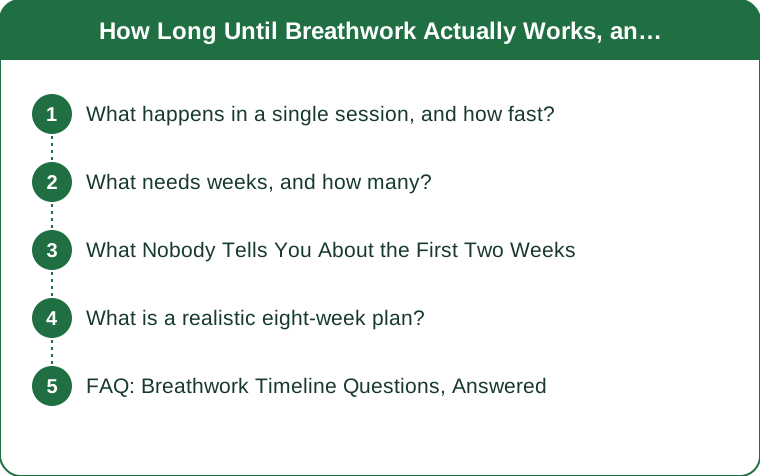
What happens in a single session, and how fast?
Faster than most people expect, and the mechanism is well understood.
Within 30 to 60 seconds of slow breathing at around 6 breaths per minute with a longer exhale than inhale, heart rate variability increases and heart rate slows on each exhale. This is a direct effect of vagal activity, and it does not require any belief, practice, or skill.
Within 2 to 5 minutes, most people report a noticeable drop in subjective tension. Studies of slow-paced breathing consistently find reductions in state anxiety over sessions of this length.
The physiological sigh - two inhales through the nose, the second one short and stacked on top of the first, followed by a long exhale - produces a measurable calming effect within a handful of breaths, and it is the fastest tool available. Repeated a few times, it is the most practical thing to reach for in an actual stressful moment.
What does not happen quickly: anything at the extreme end. Trying to control your breathing during genuine panic is famously difficult, because at that point breathing is being driven by an alarm response and asking someone to breathe slowly frequently makes them feel worse. The techniques work best before or after peak arousal, not at the top of it.
So the honest framing: a single session reliably takes the edge off, immediately. It is not going to feel dramatic, and expecting drama is one of the main reasons people conclude it did not work.
What needs weeks, and how many?
The changes people actually want - being less reactive, sleeping better, a lower resting heart rate - are adaptations, and they follow adaptation timelines.
Around 2 weeks: the technique stops requiring conscious effort. This matters more than it sounds, because until the pattern is automatic you cannot deploy it when you are stressed, which is exactly when you need it.
Around 4 weeks: most trials of daily slow-breathing practice start showing changes in resting measures - heart rate variability at rest, sleep quality ratings, and self-reported anxiety scales. This is the earliest point at which most people notice something has changed without looking for it.
6 to 8 weeks: where the blood pressure literature clusters. Studies of device-guided slow breathing for hypertension typically run 8 weeks at around 15 minutes daily, and report modest but real reductions.
8 weeks and beyond: for anxiety and stress outcomes, the trials showing the clearest results tend to be around this length with daily practice.
The dose that appears most often in this research is 5 to 20 minutes daily. Below about 5 minutes, effects on baseline measures are less consistent. Above 20 minutes, there is little evidence of additional benefit for these particular outcomes, and adherence drops sharply.
The realistic recommendation: 5 to 10 minutes daily for 8 weeks, which is short enough to actually do and long enough to be in the range that produces results.

What Nobody Tells You About the First Two Weeks
The first fortnight is where nearly everyone quits, and for three predictable reasons.
It feels like nothing is happening. The acute effect is subtle - a slight settling rather than a wave of calm - and if you were expecting something more dramatic, subtle registers as nothing. Meanwhile the baseline changes have not arrived yet. So week one and two are, in terms of noticeable results, the worst part of the whole process.
It can make you feel worse before it feels better. Slowing the breath deliberately makes some people feel short of air, which increases anxiety rather than reducing it. This is common and it usually settles within a week or two of gentler practice. Reducing the ratio - a shorter exhale extension, or simply breathing slightly slower rather than counting - fixes it for most people.
Dizziness catches people out. Almost always from breathing too deeply rather than too slowly. Slow breathing does not mean big breathing, and the correction is to keep the breaths small and quiet while lengthening the timing.
And the practical failure: no fixed time. Practices without an anchor do not survive week two. Attaching it to something that already happens daily - after brushing your teeth, before the first email, in the car before going into the house - is the difference between a habit and an intention.
One more thing worth knowing: the sessions that feel worst are not wasted. A distracted, restless five minutes still produces the physiological effect, because the mechanism is mechanical rather than mental. Feeling like you did it badly is not the same as it not working, and this misunderstanding ends more practices than any other.
What is a realistic eight-week plan?
Weeks 1 to 2: build the mechanics. 5 minutes daily. Use a simple ratio - inhale 4, exhale 6 - through the nose, breathing quietly rather than deeply. Same time each day, attached to an existing habit. The goal for this fortnight is only that it happens, not that it feels like anything.
Weeks 3 to 4: extend and add a second use. 5 to 10 minutes daily. By now the pattern should feel less effortful. Add a short in-the-moment application - three or four physiological sighs before a meeting, a difficult call, or a moment of frustration. This is what transfers the practice into your actual life.
Weeks 5 to 6: consolidate. 10 minutes daily. Most people notice something around here - falling asleep faster, a slightly longer fuse, or realising they used it automatically during something stressful without deciding to. Keep everything else the same.
Weeks 7 to 8: assess honestly. Ask specific questions rather than a general is it working. Are you falling asleep faster than in week one? Did you use it during a stressful moment without planning to? Is your resting heart rate lower, if you have a way to check? Vague self-assessment tends to conclude nothing changed even when something did.
After eight weeks: most people can maintain the benefit on 5 minutes daily plus in-the-moment use. Stopping entirely tends to see baseline measures drift back within weeks, which is consistent with it being a training effect rather than a permanent change.
This is general information, not medical advice. If you have a respiratory or cardiovascular condition, are pregnant, or have a history of panic attacks or trauma, check with a professional before starting - particularly with any technique involving breath holds or fast breathing, which are a different category from slow breathing entirely.
FAQ: Breathwork Timeline Questions, Answered
How long does it take for breathing exercises to work?
Immediate calming effects appear within 1 to 5 minutes of slow breathing and are available the first time. Lasting changes to baseline stress, sleep, and blood pressure generally need 5 to 10 minutes daily for 4 to 8 weeks.
How often should I practise breathwork?
Daily, for 5 to 10 minutes, is the pattern that appears most often in research showing results. Consistency matters considerably more than session length - five minutes every day beats thirty minutes twice a week.
Why does slow breathing make me feel worse?
Usually because you are breathing too deeply rather than too slowly, which causes dizziness, or because deliberately slowing the breath creates a sensation of not getting enough air. Keep breaths small and quiet, shorten the exhale extension, and it typically settles within a week or two.
Do I lose the benefits if I stop?
The acute technique stays available permanently - you can always use it in the moment. The baseline changes to resting heart rate variability and stress reactivity drift back over weeks without practice, which is what you would expect from a training effect.
TL;DR:
- Immediate calming appears within 1 to 5 minutes and is available the very first time you try.
- Lasting baseline change needs roughly 5 to 10 minutes daily for 4 to 8 weeks.
- Most people quit in weeks one and two, which are the worst part of the process for noticeable results.
- Feeling dizzy means you are breathing too deeply, not too slowly - keep breaths small and quiet.
- A distracted session still works; the mechanism is mechanical, not mental.
- Anchor the practice to an existing daily habit or it will not survive week two.
Decide upfront which outcome you are after. If you want the in-the-moment tool, you already have it. If you want a different baseline, give it eight weeks.
Keep Reading
This article is for general informational purposes only and is not medical advice. Always consult a qualified health professional for guidance specific to you.