Why Breathing Practice Feels Different Once the Air Turns Cold
Quick Answer: Cold air is dry air, and your airways have to warm and humidify every breath before it reaches the lungs. In cold, dry conditions that job gets harder, which produces the tightness, the dry cough, and the sense that a technique that used to feel easy now takes effort. Nasal breathing handles this far better than mouth breathing, so the practical answer is to slow down, breathe through the nose, warm the air with a scarf outdoors, and move longer sessions inside.
The box breathing that settled you all summer now makes you cough on the third round. Nothing about your practice changed.

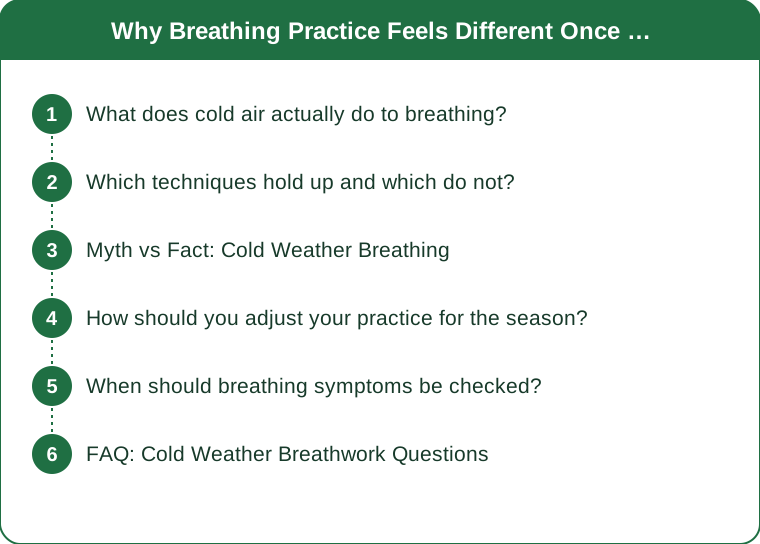
What does cold air actually do to breathing?
Cold air holds much less moisture than warm air, so cold air is nearly always dry air. Your airways have to bring every breath to roughly body temperature and near-full humidity before it reaches the lungs, and that conditioning work increases sharply in cold, dry conditions.
Water is lost from the airway lining to do it. That drying of the airway surface is thought to be the main trigger for the tightness and cough that many people experience in cold weather, and it is why the discomfort builds over a session rather than appearing immediately.
The nose is built for this and the mouth is not. Nasal passages warm and humidify air far more effectively, which is why the same breath through the mouth feels harsher. Practices built on nasal breathing translate to cold weather considerably better.
Faster and deeper breathing makes it worse in proportion. The higher the volume of air moved, the more conditioning work is required and the more the airway dries. This is why fast-paced breathwork techniques become notably less comfortable in autumn while slow ones barely change.
And for people with asthma, this is a well-recognised trigger. Cold, dry air is a common precipitant of exercise-induced and general asthma symptoms, and anyone with a diagnosis should treat autumn breathwork adjustments as part of managing that rather than as a preference.
Which techniques hold up and which do not?
Slow nasal breathing holds up almost unchanged. Extended exhale patterns, coherent breathing at around five to six breaths per minute, and simple diaphragmatic breathing all move relatively little air and stay comfortable in cold conditions.
Extended exhale work is arguably better in autumn. Longer exhales reduce overall ventilation, are strongly associated with parasympathetic activity, and produce less airway drying than balanced or fast patterns.
Box breathing generally transfers well as long as it is done nasally and the counts are not pushed to the point of forcing large volumes.
Rapid or forceful techniques are the ones that struggle. Any practice involving fast, forceful breathing moves a great deal of air, and in cold dry conditions that is where coughing and chest tightness appear. These are also the practices that carry their own precautions regardless of season.
Breath holds feel different in the cold and people frequently find their comfortable hold time shortens. That is not a loss of progress; it is a different set of conditions.
And any technique done outdoors in cold air should start slower than usual. The first two minutes are where the airway adjusts, and beginning gently prevents most of the discomfort that would otherwise arrive at minute five.
Myth vs Fact: Cold Weather Breathing
Myth: cold air damages the lungs. Fact: in healthy people, cold air causes discomfort and airway drying rather than damage. The lungs themselves receive air that has been warmed and humidified on the way. Discomfort is a signal to modify how you are breathing, not evidence of injury.
Myth: breathing through the mouth in cold weather is fine if you are used to it. Fact: mouth breathing skips most of the warming and humidifying the nose provides, and it is the single biggest factor in cold-air airway symptoms. Nasal breathing is the main protective measure available.
Myth: chest tightness in cold air is just being unfit. Fact: it is a common physiological response to dry air, and in some people it is a sign of asthma that shows up seasonally. Persistent tightness, wheeze, or a cough that lingers after exercise is worth a medical opinion rather than a training assumption.
Myth: you should stop practising outside in winter. Fact: outdoor practice in cold weather is fine for most people with a scarf over the nose and mouth and a slower pace. Daylight exposure in autumn and winter has its own considerable value, and going outside is worth preserving.
Myth: deeper breaths are better in cold air. Fact: larger volumes require more conditioning and dry the airway faster. Slow, small, nasal breaths are more comfortable and, for most calming purposes, more effective anyway.
The pattern: nearly everything that goes wrong in cold-weather breathwork comes from moving too much air, too fast, through the wrong opening.

How should you adjust your practice for the season?
Move longer sessions indoors and keep short ones outside. Twenty minutes of slow breathing is better done in a warm room; five minutes outdoors on a cold morning is pleasant and delivers daylight exposure at the same time.
Use a scarf, buff, or mask over the nose and mouth outdoors. It traps warmth and moisture from your own exhale and pre-warms the next inhale. This is simple, well-established, and the most effective single measure for outdoor cold-air comfort.
Warm up the breathing itself. Two minutes of easy nasal breathing before any structured practice lets the airway adjust, in the same way you would warm up before exercise.
Address indoor dryness too, because heating creates it. Heated indoor air is often very dry, which produces similar symptoms without the cold. A humidifier, or a bowl of water near a radiator, makes indoor practice noticeably more comfortable in winter.
Hydrate, since airway conditioning uses water. It is a small effect and it is a real one, and people drink less when the weather is cool.
And shorten sessions rather than pushing through discomfort. Five comfortable minutes builds a practice that survives the winter; fifteen uncomfortable ones build a reason to skip tomorrow.
When should breathing symptoms be checked?
A cough, wheeze, or chest tightness that persists after you stop is different from transient discomfort during cold-air breathing, and it warrants a medical opinion.
Symptoms that consistently appear with exercise in cold weather are a classic presentation of exercise-induced bronchoconstriction, which is common, frequently undiagnosed, and very treatable.
Breathlessness disproportionate to what you are doing, or that has worsened over weeks, is worth investigating rather than adapting around.
Existing asthma with worsening autumn symptoms means the management plan needs reviewing - autumn brings cold air, indoor allergens, and respiratory viruses together, and a plan that worked in July may not be adequate.
Dizziness, tingling, or feeling faint during breathwork means stopping and sitting down. This can happen with fast or forceful techniques regardless of season, and those techniques should not be practised in water, while driving, or standing up.
And anyone with a cardiovascular condition, respiratory condition, or who is pregnant should get individual advice before taking up intensive breathwork practices. Slow, gentle breathing is broadly appropriate; fast and forceful techniques and prolonged breath holds are not universally so. This is general information, not medical advice.
FAQ: Cold Weather Breathwork Questions
Why does breathing exercise feel harder in cold weather?
Cold air is dry air, and your airways must warm and humidify every breath before it reaches the lungs. That conditioning work draws water from the airway lining, which produces the tightness and dry cough. It builds over a session, which is why the discomfort tends to arrive a few minutes in.
Should I breathe through my nose in cold air?
Yes - the nose warms and humidifies air far more effectively than the mouth, and nasal breathing is the single most useful protective measure. Techniques built around nasal breathing translate to cold weather much better than mouth-breathing ones.
Can I do breathwork outside in autumn and winter?
For most people, yes - with a scarf or buff over the nose and mouth to trap warmth and moisture, a slower pace, and shorter sessions. Keep longer practices indoors and use the outdoor ones for daylight exposure, which is valuable in itself during darker months.
Is chest tightness in cold air a sign of asthma?
It can be. Cold, dry air is a well-recognised asthma trigger, and exercise-induced bronchoconstriction is common and frequently undiagnosed. Discomfort during cold-air breathing that settles quickly is usually normal; a cough, wheeze, or tightness that persists afterwards warrants a medical opinion.
TL;DR:
- Cold air is dry air, and warming and humidifying each breath draws water from the airway lining - that is the tightness and the cough.
- The nose does that job far better than the mouth, so nasal breathing is the main protective measure.
- Slow techniques and extended exhales transfer to cold weather almost unchanged; fast, forceful ones do not.
- Use a scarf or buff outdoors to trap warmth and moisture from your own exhale.
- Warm the breathing up for two minutes before structured practice, and shorten sessions rather than pushing through.
- Heated indoor air is very dry too - a humidifier makes winter indoor practice noticeably better.
A cough or tightness that persists after you stop is worth a doctor’s opinion. This is general information, not medical advice.
Keep Reading
This article is for general informational purposes only and is not medical advice. Always consult a qualified health professional for guidance specific to you.