What Is the Physiological Sigh, and Why Does It Calm You So Fast?
Quick Answer: The physiological sigh is a double inhale through the nose (a full breath followed immediately by a second shorter top-up inhale) followed by a long, slow exhale through the mouth — research from Stanford identifies it as the fastest known breathing technique for reducing physiological stress markers in real time, often working within 1-3 repetitions.
Most breathing techniques take minutes of practice to feel a shift. The physiological sigh is different — it’s the pattern your body already uses automatically when you’re overwhelmed and involuntarily sigh, and doing it deliberately taps the same fast-acting mechanism.
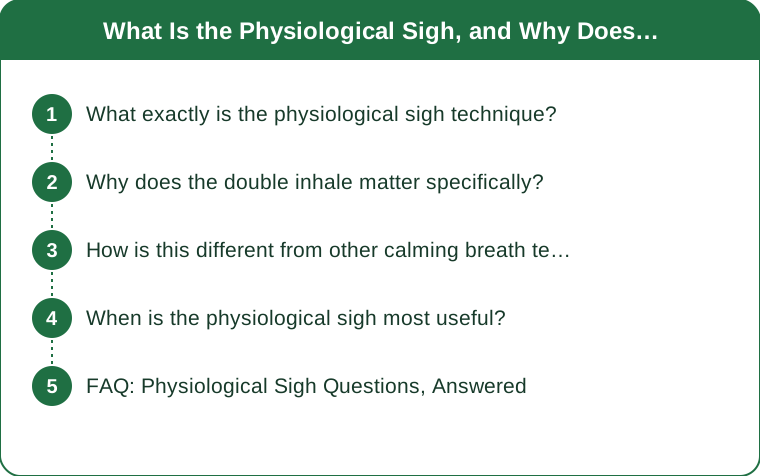
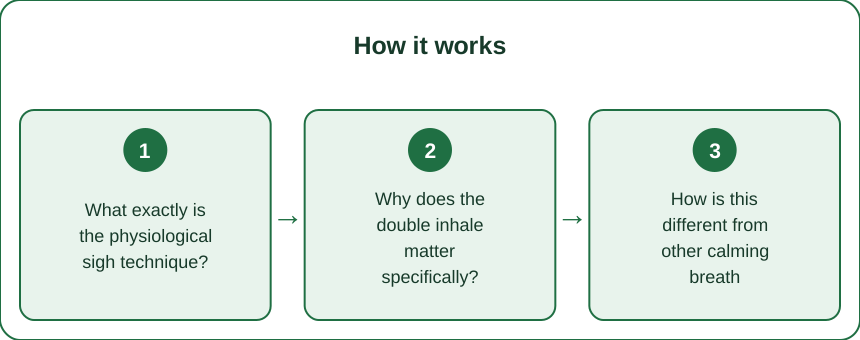
What exactly is the physiological sigh technique?
Step 1: Inhale deeply through your nose until your lungs feel full. Step 2: Without exhaling, take a second, shorter sharp inhale through the nose immediately after — this tops off your lung capacity further and re-inflates any collapsed air sacs (alveoli) in the lungs. Step 3: Exhale slowly and fully through your mouth, longer than either inhale, ideally emptying your lungs as completely as possible.
Repeat 1-3 times. Unlike box breathing or 4-7-8 breathing, which require sustained multi-minute practice, research on the physiological sigh has found measurable calming effects from just a single cycle.
Why does the double inhale matter specifically?
The second, shorter inhale re-inflates alveoli (tiny air sacs) that partially collapse during normal breathing, particularly under stress when breathing tends to become shallow and rapid. This re-inflation allows for a more complete gas exchange on the following exhale, which is where the calming effect concentrates — the long exhale specifically activates the parasympathetic nervous system (the body’s rest-and-recover mode) more strongly than the inhale phase does.
This is the exact mechanism behind spontaneous sighing — your body does this automatically and unconsciously multiple times per hour to reset breathing efficiency, and doing it deliberately during acute stress accelerates that same reset.

How is this different from other calming breath techniques?
Box breathing (4-4-4-4 count) and 4-7-8 breathing both work by extending breath duration and requiring sustained, multi-cycle practice to build a calming effect over several minutes. The physiological sigh’s mechanism is more immediate — the double-inhale, long-exhale structure produces a measurable shift in stress markers within a single cycle in controlled research, making it specifically useful for acute, in-the-moment stress (before a difficult conversation, mid-panic, right before a stressful meeting) rather than a longer meditative practice.
When is the physiological sigh most useful?
It’s best suited for acute, sudden stress spikes where you need a fast reset — right before walking into a stressful situation, in the middle of a panic moment, or when you notice your breathing has become shallow and rapid. It’s less suited as a sustained relaxation practice (a longer session of slow breathing or meditation serves that purpose better) — think of it as a fast circuit-breaker rather than a wind-down ritual.
FAQ: Physiological Sigh Questions, Answered
How many physiological sighs should I do at once?
1-3 cycles is typically enough for a noticeable shift — more isn’t necessarily better, and doing many in a row can cause lightheadedness for some people.
Can the physiological sigh help with panic attacks?
Many people find it helpful as an in-the-moment tool, though it’s not a replacement for professional support if panic attacks are frequent or severe. This is general information, not medical advice.
Is the physiological sigh backed by real research?
Yes — it comes out of Stanford neuroscience research on breathing and stress physiology, specifically comparing it against other breathing patterns for real-time stress reduction speed.
TL;DR:
- Double inhale through the nose (full breath + short top-up) then a long, slow exhale through the mouth
- Just 1-3 cycles produce measurable stress-marker changes in research, faster than most other techniques
- The long exhale is where most of the calming effect concentrates
- Best for acute stress spikes, not as a substitute for longer relaxation practice
This is general information, not medical advice — if panic or anxiety symptoms are frequent, a professional evaluation is worth pursuing alongside any breathing technique.
Keep Reading
This article is for general informational purposes only and is not medical advice. Always consult a qualified health professional for guidance specific to you.