Nasal Breathing During Workouts: Worth the Hype or Just Harder?
Quick Answer: Nasal breathing during easy-to-moderate exercise filters and humidifies air, encourages slower diaphragmatic breathing, and acts as a built-in intensity governor that keeps easy days honestly easy. At genuinely hard intensities, switching to the mouth is not failure - it is physics, because the nose cannot move enough air. Use nose-only for warm-ups, easy cardio, and between-set recovery; expect a four-to-six-week adaptation where your pace temporarily drops; and ignore anyone selling it as a universal upgrade.
The topic arrives wrapped in either mysticism or dismissal, and both miss the useful middle: nasal breathing is a legitimate training tool with a specific job description. Knowing the job - and the hours it does not work - is what separates a practice you keep from a trend you abandon by Labor Day.

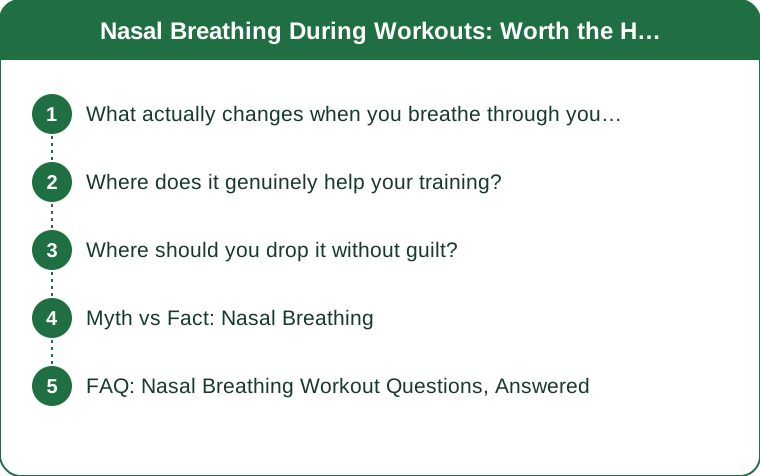
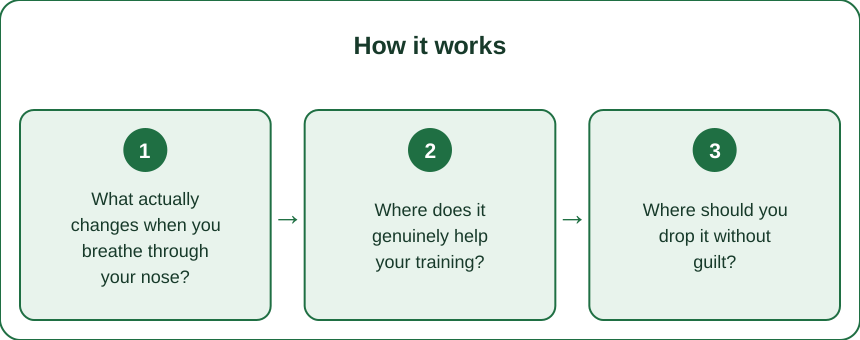
What actually changes when you breathe through your nose?
The air arrives processed. The nasal passages warm, humidify, and filter air before it reaches the lungs - which is why cold-morning runs and dusty trails feel harsher through the mouth, and why nose-breathers often report less of the post-run throat rasp.
The breathing pattern slows and deepens. The nose is a narrower pipe, so each breath takes longer and tends to recruit the diaphragm more fully rather than the shallow upper-chest pattern mouth panting encourages. Slower, deeper breathing at easy intensities is more mechanically efficient and pairs with a calmer nervous-system state - the same reason every relaxation protocol on earth starts with the nose.
Nitric oxide joins the mix. The sinuses continuously produce small amounts of nitric oxide, which travels with nasal air into the lungs and modestly supports airway and blood-vessel dilation - a physiological footnote, interesting rather than transformative.
And the governor engages. This is the practical headline: at some effort level, nose-only simply cannot supply enough air, and you are forced to slow down. That ceiling sits conveniently near the top of the easy aerobic zone for most people - which converts nasal breathing into a wearable-free zone-2 enforcement device. The chronic problem of easy days drifting into medium days solves itself when the rule is lips together.
Where does it genuinely help your training?
Easy aerobic work - the core use case. Long walks, easy runs, casual rides, steady swims-adjacent cardio: nose-only keeps the intensity where the plan intended, deepens the breathing pattern, and for many people turns easy sessions almost meditative. If you struggle to believe your easy pace should feel that easy, the nose will make the argument for you, mile after mile.
Warm-ups, universally. The first ten minutes of anything - lifting included - through the nose eases the ramp from resting to working, encourages diaphragm engagement before load arrives, and postpones the sympathetic red-line until it is actually useful.
Between-set and between-interval recovery. Closing the mouth after a hard effort and taking slow nasal breaths with long exhales measurably calms heart rate faster than continued panting for many trainees - and at minimum it stops the frantic gasping posture that keeps the nervous system in alarm.
Everyday base-building. The most durable benefit may be off the workout clock entirely: habitual daytime nasal breathing - at the desk, on walks, watching TV - trains the pattern that then shows up for free during exercise. Late summer is a friendly build window for it, too; starting nose-only outdoor sessions in humid August air is easier than debuting in January, when frigid dry air makes the nose’s job hardest.

Where should you drop it without guilt?
At real intensity - by design. Intervals, hill repeats, heavy sets, race efforts: the mouth exists for exactly this. Above moderate effort, air demand exceeds what the nasal pipe can flow, and forcing nose-only either caps the effort (defeating the workout’s purpose) or produces air hunger, form collapse, and a panic overlay on what should be clean hard work. Mouth breathing during hard efforts is not a technique failure; it is the respiratory system shifting gears as built. The elegant pattern many settle into: nose for easy and recovery, nose-in-mouth-out for medium, full mouth for hard.
During congestion, allergies, and colds. Ragweed season starts in late August across much of the US, and a blocked nose turns nose-only into a suffocation drill. Exercise itself partially decongests - the first ten minutes often open things noticeably - but a genuinely blocked nose earns a mouth-breathing day without ceremony.
When form is degrading under load. If nose-only is causing you to cut lifts short of brace, or making your running form ragged while you fight for air, the tool is interfering with the workout it was meant to serve.
And skip the tape trend for workouts. Mouth-taping during exercise removes your overflow valve exactly when you might need it. Whatever its evening relaxation uses, during training the mouth stays available - the discipline is voluntary, never mechanical.
Myth vs Fact: Nasal Breathing
Myth: Nasal breathing raises your VO2 max. Fact: No solid evidence supports nose-only as a direct fitness enhancer. Its value is indirect - honest easy days, better breathing mechanics, calmer recovery - which can support fitness the ordinary way: through better-executed training.
Myth: Elite athletes nose-breathe through everything. Fact: Elites nose-breathe easy work and mouth-breathe hard work like everyone else with functioning physiology. The all-nose-all-the-time claim survives only in marketing.
Myth: Mouth breathing during a workout means you are unfit. Fact: It means the intensity crossed the nose’s flow ceiling - which is the definition of hard work arriving. Fitness moves the ceiling; it never removes it.
Myth: The adaptation is instant if your nose is healthy. Fact: Expect four to six weeks of feeling air-limited at paces that used to be automatic, with easy paces temporarily 30 to 60 seconds per mile slower. The pattern re-learns; the impatience is the main dropout cause.
Myth: It fixes sleep, anxiety, and focus by itself. Fact: Nasal-dominant breathing associates with calmer states and is one worthwhile input among many. Anyone promising a respiratory personality transplant is selling something.
FAQ: Nasal Breathing Workout Questions, Answered
Should I breathe through my nose while running?
On easy runs, yes - it keeps the effort honestly aerobic and the pattern deep. On intervals and races, mouth-breathe freely; that is the system working as designed.
How long does it take to adapt to nasal breathing during exercise?
Most people need four to six weeks of nose-only easy sessions before former paces return at the same effort. Start with warm-ups and the easiest days, and let the pace drop without protest.
Why can I not nose-breathe even at easy paces?
Common causes: an easy pace that is not actually easy, unmanaged allergies or congestion, or a genuinely restricted nasal airway. Slow down first; treat the allergies second; and if one or both nostrils never flow well, that is a conversation with a professional. This is general information, not medical advice.
Does nasal breathing burn more fat or change metabolism?
Not directly. By holding you at lower intensities, it keeps you in ranges where fat supplies a larger share of fuel - an intensity effect, not a nose effect. Total training and diet still decide outcomes.
TL;DR:
- Nose-only at easy intensities filters air, deepens the pattern, and enforces honest zone-2 - the governor is the feature.
- Mouth breathing at hard intensities is correct physiology, not failure; nose for easy, mouth for hard, blends between.
- Adaptation costs four to six weeks of slower easy paces; congestion days and ragweed season earn exceptions without guilt.
- Skip workout mouth-taping and the miracle claims - the real benefits are quiet ones, compounding across ordinary sessions.
The nose is a governor, a filter, and a metronome; the mouth is the overflow valve. Use each for its actual job and nasal breathing stops being a trend to have opinions about - it becomes the reason your easy days finally do what easy days are for.
Keep Reading
This article is for general informational purposes only and is not medical advice. Always consult a qualified health professional for guidance specific to you.