What to Actually Do When You Wake at 3am and Cannot Get Back to Sleep
Quick Answer: At 3am the problem is usually a stress response that’s already started, not difficulty winding down. Use extended exhale breathing - inhale for four, exhale for eight, for five to ten minutes - which activates the parasympathetic system more directly than counted box breathing. Do it lying still with your eyes closed, and don’t check the time, because the arithmetic of how many hours are left is itself the thing keeping you awake.
There’s a particular kind of awake that happens at 3am. You weren’t dreaming, nothing woke you, and within about forty seconds your mind has found something to work on.
The advice that works for falling asleep at bedtime - wind down, dim lights, breathe slowly - mostly doesn’t work here, because you’re not trying to wind down from a busy evening. You’re trying to interrupt a physiological arousal that’s already underway.

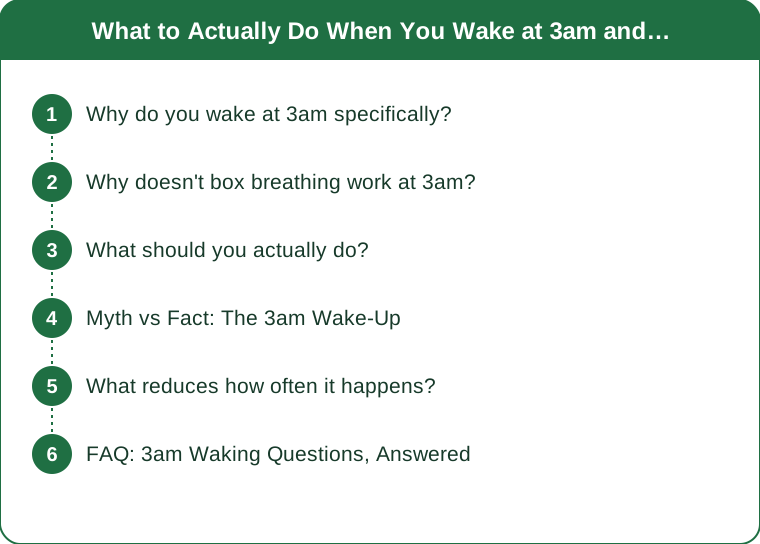
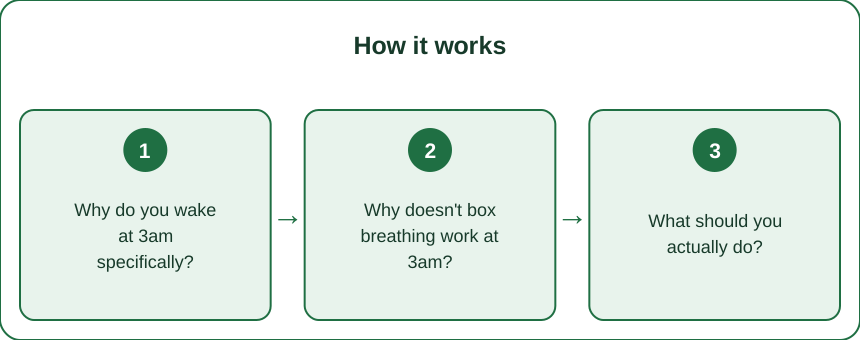
Why do you wake at 3am specifically?
Several things converge in the small hours, and knowing which one applies changes what helps.
Cortisol is already rising. Cortisol follows a daily rhythm with its lowest point around midnight and a rise beginning in the early hours, peaking shortly after waking. By 3am the rise has started, and if you’re carrying elevated baseline stress, that ordinary rise can be enough to cross the threshold into wakefulness.
Sleep architecture changes across the night. Deep slow-wave sleep dominates the first half; the second half has proportionally more REM and lighter sleep. You’re closer to the surface at 3am than at midnight, so a smaller disturbance wakes you.
Body temperature reaches its minimum in the early hours, and the transition around that point is associated with lighter sleep.
Brief awakenings are entirely normal. Everyone surfaces several times a night. The difference between people who sleep well and people who don’t is largely what happens next - most awakenings are forgotten within seconds, and the ones that become a problem are the ones where the mind engages.
And that’s the crucial point: the waking is usually normal. What turns it into ninety minutes awake is the second stage - the thought, then the frustration about being awake, then the arithmetic about how tired you’ll be, each of which raises arousal further. The breathing work is aimed at that second stage, and it’s the only part you can actually intervene on.
Why doesn’t box breathing work at 3am?
Because it’s the wrong tool for this specific job, and it has one property that actively works against you.
Box breathing - four in, four hold, four out, four hold - was developed for performance under stress. It’s balanced and it requires attention. The equal ratio and the holds don’t preferentially activate the parasympathetic system, which is what you need at 3am.
The mechanism that matters is the exhale. Heart rate rises slightly on inhalation and falls on exhalation - this is respiratory sinus arrhythmia, and it’s driven by vagus nerve activity. A longer exhale relative to inhale spends more of each cycle in the parasympathetic-dominant phase. That’s the whole reason extended-exhale breathing calms you and equal-ratio breathing does so less.
The second problem with box breathing at 3am is the counting. It requires enough attention to keep you cognitively engaged. You’re not trying to focus - you’re trying to disengage. Any technique demanding real concentration keeps a part of your brain online, and that part is what’s stopping you sleeping.
What you want instead: a long exhale, minimal counting, no holds, and something that gets boring quickly. Boring is a feature.
What also doesn’t help at 3am: anything requiring you to sit up, any app you’d need to unlock your phone for, and any technique involving forceful breathing - Wim Hof style breathing and breath of fire are stimulating by design and are exactly wrong here.
What should you actually do?
A sequence, in order, starting the moment you notice you’re awake.
Step 1: Don’t check the time. This is the single most important instruction and the hardest to follow. Knowing it’s 3:14 starts the arithmetic - three hours and forty-six minutes left, tomorrow is going to be terrible - and that calculation is itself arousing. Turn the clock away, and if you check your phone, that’s screen light on top of it.
Step 2: Stay still and stay lying down for at least the first fifteen minutes. Movement and getting up raise alertness.
Step 3: Extended exhale breathing.
- Inhale through the nose for a count of 4
- Exhale through the nose, or through slightly pursed lips, for a count of 8
- No holds. No forcing.
- Continue for 5 to 10 minutes
If 4:8 feels like a strain, use 4:6. The exact numbers don’t matter; the exhale being clearly longer than the inhale is what matters. Straining to hold a ratio is counterproductive - it introduces exactly the effort you’re trying to remove.
Step 4: If the mind is racing, add a body scan rather than fighting the thoughts. Move attention slowly from toes upward, a few seconds per area, keeping the breathing going. This occupies the verbal part of the mind with something monotonous, which is more effective than trying to think about nothing.
Step 5: If you’re still awake after roughly 20 to 25 minutes and it’s becoming frustrating, get up. Go to another room, keep the lights very low, read something undemanding on paper, and return when sleepy. Lying awake frustrated for an hour teaches your brain that the bed is a place for being awake, which is what turns a bad night into a pattern. Getting up feels like giving in and it’s the evidence-based instruction.

Myth vs Fact: The 3am Wake-Up
Myth: Waking in the night means something is wrong with your sleep. Fact: Brief awakenings are a normal feature of sleep architecture and everyone has them. Historical evidence suggests segmented sleep - a first and second sleep with a waking period between - may have been common before artificial lighting. The waking isn’t pathological; the distress about it is what makes it a problem.
Myth: You should stay in bed and keep trying. Fact: Beyond about 20-25 minutes of frustrated wakefulness, staying in bed strengthens an association between the bed and being awake. Getting up briefly and returning when sleepy is standard practice in cognitive behavioural therapy for insomnia, which is the first-line treatment for chronic insomnia.
Myth: Deep, forceful breathing calms you down. Fact: Forceful or rapid breathing is stimulating and can cause light-headedness by lowering carbon dioxide. What calms is slow, gentle, long-exhale breathing. Effortful is the wrong direction entirely.
Myth: If you can’t sleep, you may as well be productive. Fact: Working, reading email, or planning at 3am raises arousal and creates a strong association between wakefulness and mental activity. It also makes the next night’s waking more likely.
Myth: One bad night ruins the next day. Fact: A single night of poor sleep has measurable but modest effects, and humans function reasonably on it. This matters because the anxious prediction of a ruined day is a significant part of what keeps people awake - the catastrophising is often more costly than the lost sleep.
What reduces how often it happens?
The 3am technique manages the symptom. These reduce the frequency.
Alcohol is the most common controllable cause. It sedates initially and then fragments the second half of the night as it’s metabolised. The classic pattern is falling asleep easily and waking at 3am after evening drinking. Even moderate amounts do this reliably.
Blood glucose. For some people, a large gap between an early dinner and morning produces a nocturnal wake-up. A small protein-containing snack before bed is worth testing for a week if that pattern fits.
Bedroom temperature. Core temperature drops overnight and a warm room interferes with it. 16-19C is the general recommendation, and a room that was fine in July can be too warm once the heating comes on in autumn.
Consistent wake time. More important than consistent bedtime for stabilising the circadian rhythm. The same wake time seven days a week, including after a bad night, is the single most effective structural change - and lying in to compensate is what perpetuates the cycle.
Morning light. Ten to twenty minutes of outdoor light shortly after waking anchors the rhythm and improves sleep pressure that evening. It’s free, and it’s more effective than most things people buy.
Daytime stress load. Elevated baseline stress means the ordinary early-morning cortisol rise is more likely to cross into wakefulness. Which means the daytime practice - regular slow breathing during the day, not just at 3am - lowers the baseline and does more for night waking than anything you do at night.
When to seek help: if night waking happens most nights for over three months, or if you snore heavily and wake unrefreshed - the latter warrants asking about sleep apnoea specifically. CBT-I is first-line for chronic insomnia and is more effective long-term than sleep medication.
FAQ: 3am Waking Questions, Answered
How long should I do the breathing before expecting it to work?
Five to ten minutes. Many people fall asleep during it, which is the point. If you’re still fully awake after fifteen, switch to the body scan, and after 20-25 minutes of frustration, get up.
Is 4-7-8 breathing better?
It’s a reasonable extended-exhale pattern and it works on the same principle. The hold makes it slightly more demanding to sustain, and some people find it produces air hunger. If 4-7-8 works for you, use it; if it feels strained, drop to 4:8 with no hold.
Should I use a sleep app or audio guide?
Only if you can play it without looking at a screen and without it ending in something that requires interaction. The phone in the hand at 3am is a bigger problem than the technique is a solution - a smart speaker or a pre-set audio with the screen face down is better.
Does it matter if I breathe through my nose or mouth?
Nasal breathing is generally preferable - it’s slower, warms and humidifies the air, and is associated with better sleep quality. Exhaling through pursed lips is fine if it helps you extend the exhale.
Why does it always happen at almost exactly the same time?
Circadian rhythms are strongly time-anchored, and a repeated wake-up can become a learned pattern reinforced each time it happens. The consistent-wake-time and morning-light interventions target exactly this, and it usually takes a few weeks to shift.
TL;DR:
- The 3am problem is an arousal that’s already started, not difficulty winding down
- Extended exhale - 4 in, 8 out, no holds - activates the parasympathetic system more directly than box breathing
- Don’t check the time; the arithmetic about hours remaining is itself arousing
- Add a slow body scan if thoughts race - monotony beats trying to think about nothing
- After 20-25 frustrated minutes, get up, low light, paper, return when sleepy
- Reduce frequency with consistent wake time, morning light, cooler bedroom, and less evening alcohol
Waking at 3am is normal. What makes it a ninety-minute problem is the second stage, and a long slow exhale is the most direct way to interrupt it.
Keep Reading
This article is for general informational purposes only and is not medical advice. Always consult a qualified health professional for guidance specific to you.