Breathwork for Sunday Night Dread — What Works and What Makes It Worse
Quick Answer: Sunday dread is anticipatory anxiety — the discomfort is about tomorrow, not about now — so techniques designed to interrupt acute panic tend to do nothing or make you more aware of the feeling. What works is extended exhale breathing done early in the evening, before the dread peaks, paired with a concrete action that reduces the actual uncertainty. Breathing lowers the arousal; it does not answer the question your brain is asking.
It arrives somewhere around six. Not a thought exactly — a heaviness that turns the last four hours of the weekend into a countdown.
And then you try box breathing, and somehow you feel more aware of it than you did before.
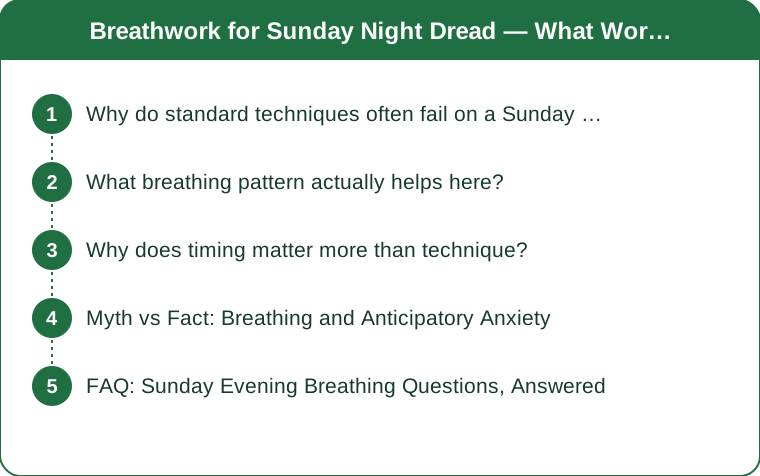
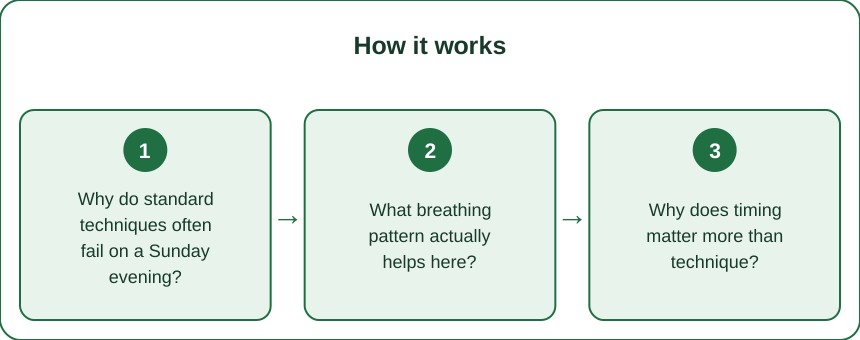
Why do standard techniques often fail on a Sunday evening?
Because most popular breathing techniques were designed for a different problem.
Box breathing, 4-7-8, and the physiological sigh are all effective at reducing acute arousal — the racing heart, the shallow chest breathing, the immediate physical spike. That is a state your body is currently in, and breathing directly modulates it.
Sunday dread is usually not that state. It is anticipatory: low-grade, sustained, and cognitive. Your heart rate is probably fine. Your breathing is probably fine. What is happening is that your brain is running simulations of Monday, and each simulation produces a small unpleasant response.
This creates two specific failure modes:
Nothing happens, and you conclude breathwork does not work for you. You did four rounds of box breathing, your arousal was already low, and so nothing changed. The technique was fine; the target was wrong.
It gets worse, through attentional focus. Sitting still and directing attention inward, when the thing bothering you is a stream of thoughts, gives those thoughts a quiet room and your full attention. This is a well-known effect and it catches people out badly — the same stillness that helps in acute anxiety amplifies rumination.
So the question is not which technique. It is when, and paired with what.
What breathing pattern actually helps here?
Extended exhale, low effort, long duration. Not a sharp intervention — a slow downshift.
The mechanism worth knowing: exhaling longer than you inhale biases the autonomic nervous system toward the parasympathetic side. Heart rate falls slightly on exhale and rises slightly on inhale, and lengthening the exhale relative to the inhale nudges the overall balance. It is a modest effect per breath and a meaningful one over ten minutes.
The pattern:
- Inhale through the nose for a count of 4.
- Exhale through the nose, or through slightly pursed lips, for a count of 6 to 8.
- No holds. Holds add effort and effort is counterproductive here.
- Ten minutes, not two. Duration is doing the work.
The ratio matters more than the numbers. If 4 and 6 feels strained, use 3 and 5. Strain defeats the purpose entirely — you cannot downregulate while working hard at breathing.
Two adjustments specific to Sunday:
Do it moving, or with your eyes open. A slow walk with the same breathing ratio works better than sitting still for most people with anticipatory anxiety, because it occupies enough attention to prevent rumination while still delivering the breathing effect.
Do it at six, not at ten. This is the single most important point on the page and the section below is about why.
Why does timing matter more than technique?
Because you are trying to flatten a curve, not stop a spike.
Sunday dread typically builds through the evening and peaks somewhere between 9 and 11pm, right when you are also trying to sleep. Intervening at the peak means fighting the strongest version of it with the least energy, while lying still in the dark — the exact conditions that favour rumination.
Intervening at 6pm, before it has built, works substantially better for three reasons:
Lower starting arousal means the same intervention has more effect. Ten minutes of extended exhale from a moderate baseline moves you further than ten minutes from a high one.
You have capacity to pair it with action. At 6pm you can still write tomorrow’s first task on a piece of paper, lay out clothes, or send the one message that is sitting on your chest. At 10:30 you can only think about them.
It changes the shape of the evening. The dread is partly maintained by treating Sunday evening as pre-Monday. An intentional ten minutes at six marks the evening as its own thing rather than a waiting room.
A concrete sequence that works:
- 6:00pm — ten minutes of 4-in, 6-out, walking or sitting with eyes open.
- Immediately after — five minutes writing down the first three things you will do tomorrow, in order. Not a full plan. Three items.
- 9:30pm — a shorter version, four or five minutes, in bed or just before, with a longer exhale.
The writing step is not optional decoration. Breathing addresses arousal; the uncertainty about tomorrow is a separate input, and it keeps regenerating the arousal if you leave it alone.
Myth vs Fact: Breathing and Anticipatory Anxiety
Myth: If a technique does not work, you are doing it wrong. Fact: More often you are applying an acute-arousal tool to a low-arousal cognitive state. Box breathing is genuinely excellent before a presentation and genuinely mediocre against Sunday rumination. Different problem, different tool.
Myth: Longer holds mean deeper relaxation. Fact: Holds increase effort and, for many people, increase air hunger, which is arousing rather than calming. For anticipatory anxiety specifically, drop the holds entirely and just extend the exhale.
Myth: You should breathe as slowly as possible. Fact: There is a comfortable range, roughly five to seven breaths per minute for most adults, and pushing below it produces strain. Strain activates the system you are trying to settle. Slower is not automatically better.
Myth: Sitting still is required. Fact: For rumination-driven anxiety, stillness is frequently the problem. Walking with a controlled breathing ratio delivers most of the physiological benefit while denying rumination the empty attentional space it needs. This is the single most useful adjustment on this list and almost no one is told it.
Myth: If breathing does not fix it, nothing will. Fact: Breathing is one input among several. Sleep timing, Sunday afternoon structure, how Friday afternoon was left, and whether Monday morning has a defined first task all matter, several of them more than the breathing does.
FAQ: Sunday Evening Breathing Questions, Answered
How long before I notice anything?
Within a single ten-minute session you should feel a modest settling — not dramatic, more like the volume coming down slightly. The larger effect is cumulative over three or four weeks of doing it at the same time, because the ritual itself starts to act as a cue.
What if breathing exercises make me feel dizzy or more anxious?
Stop, breathe normally, and reduce the effort substantially. Dizziness usually means you are moving too much air — breathing too deeply or too fast for the pace. Keep the inhale small and quiet through the nose. If it consistently happens even at low effort, or if anxiety is significantly affecting your life, that is worth discussing with a doctor or a therapist. This is general information, not medical advice.
Is Sunday dread a sign I should change jobs?
Sometimes, and sometimes not. A useful distinction: dread that resolves within an hour of starting on Monday is usually about anticipation and transition. Dread that persists through Monday and into the week is information about the job itself. Both are worth taking seriously, but they point in different directions.
Does doing this on other evenings help?
Yes, and it is probably more effective than doing it only on Sundays. A daily ten-minute extended-exhale practice at a fixed evening time makes the Sunday version routine rather than a rescue attempt, and rescue attempts are inherently less effective because they come with the expectation of needing rescue.
TL;DR:
- Sunday dread is anticipatory, not acute. Tools designed for panic spikes often do nothing or amplify rumination.
- Use extended exhale: inhale 4, exhale 6 to 8, no holds, ten minutes. Ratio matters more than the numbers.
- Do it at 6pm, not 10pm. You are flattening a curve, not stopping a spike.
- Walk while you do it, or keep your eyes open. Stillness gives rumination a quiet room.
- Pair it with writing tomorrow’s first three tasks. Breathing handles arousal; uncertainty needs a separate answer.
The technique was probably fine. The timing and the target were wrong. This is general information, not medical advice.
Keep Reading
This article is for general informational purposes only and is not medical advice. Always consult a qualified health professional for guidance specific to you.