The Breathing Technique That Actually Helps With Cold Exposure (and the One That Doesn't)
Quick Answer: Slow, controlled exhales are what actually calm the gasp reflex during cold exposure — techniques that emphasize rapid, forceful breathing beforehand (popularized on social media) can actually work against you by over-arousing the nervous system right before a stressor that already spikes it.
You’ve seen the viral cold plunge videos with dramatic rapid breathing beforehand and assumed that’s the technique to copy. For most people, it’s closer to the opposite of what actually helps in the water.
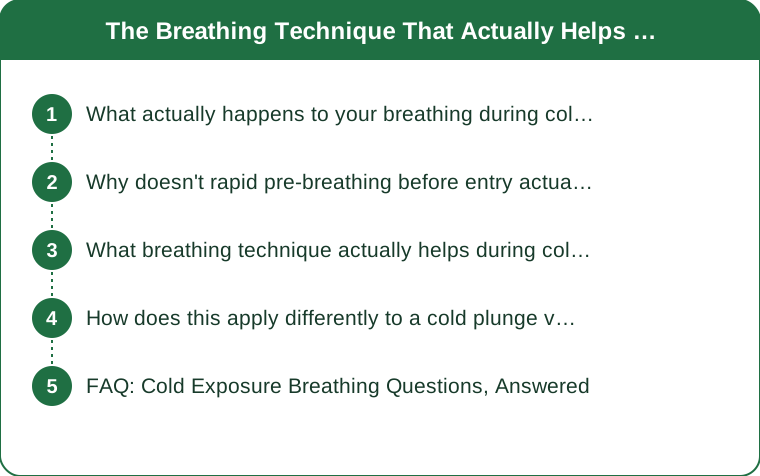
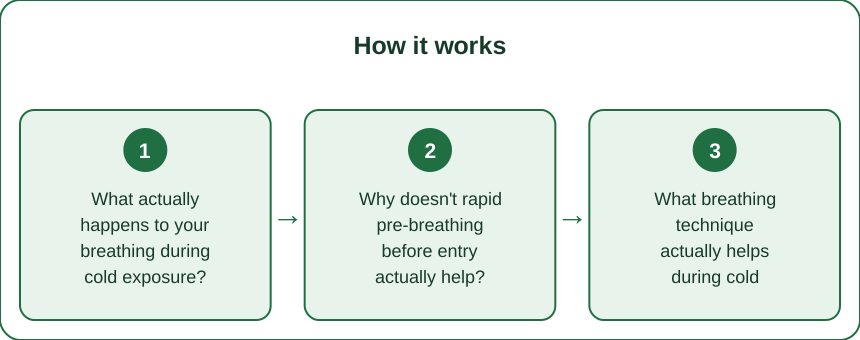
What actually happens to your breathing during cold exposure?
Sudden cold triggers an involuntary ‘cold shock response’ — a sharp gasp reflex and rapid, shallow breathing that can genuinely be dangerous in open water, since it disrupts voluntary breath control right when you need it most. This reflex is the actual problem cold-exposure breathing techniques need to solve.
Why doesn’t rapid pre-breathing before entry actually help?
Fast, forceful breathing patterns before cold entry increase physiological arousal and can leave you already activated right as the cold shock response hits — stacking two arousal spikes on top of each other, rather than building a calm baseline to absorb the shock from.

What breathing technique actually helps during cold exposure?
Slow, controlled exhales — longer than the inhale — activate the parasympathetic nervous system and directly counter the gasp reflex. A simple pattern many practitioners use: inhale for 4 counts, exhale for 6-8 counts, starting just before entry and continuing through the first 30-60 seconds, which is when the cold shock response is strongest.
How does this apply differently to a cold plunge versus a cold shower?
A full cold plunge triggers a stronger cold shock response than a cold shower, since more of the body is submerged at once — slow-exhale breathing matters more here. For a cold shower, the same technique still helps, but the lower intensity means most people adapt within the first 15-20 seconds regardless.
FAQ: Cold Exposure Breathing Questions, Answered
Should I hyperventilate before a cold plunge like I’ve seen online?
This is generally not recommended for cold water immersion specifically — it can increase arousal right before a stressor that already spikes your nervous system, and in open water settings raises real safety concerns.
How long does the cold shock response typically last?
Most people find the sharpest gasp-reflex phase passes within 30-60 seconds with steady breathing, after which breathing becomes easier to control voluntarily.
Is cold exposure breathwork safe for everyone?
People with cardiovascular conditions should check with a doctor before cold water immersion specifically, since the cold shock response places real, sudden stress on the heart.
TL;DR:
- The cold shock response causes involuntary rapid, shallow breathing — that’s the actual problem to solve
- Rapid pre-breathing before entry can increase arousal rather than help
- Slow, controlled exhales (longer than the inhale) counter the gasp reflex more effectively
- The sharpest phase typically passes within 30-60 seconds of steady breathing
This is general information, not medical advice — anyone with a cardiovascular condition should check with a doctor before cold water immersion.
Keep Reading
This article is for general informational purposes only and is not medical advice. Always consult a qualified health professional for guidance specific to you.