4-7-8 Breathing: Why It Backfires for Some People
Quick Answer: The extended 7-second hold in 4-7-8 breathing can trigger a mild air-hunger response in people prone to anxiety, which paradoxically increases stress rather than calming it — a technique without a long hold, like box breathing or extended exhale breathing, often works better for that group.
4-7-8 breathing gets recommended broadly as a universal calming technique, but for a meaningful subset of people, particularly those with anxiety sensitivity, the long breath-hold component works against its intended effect.
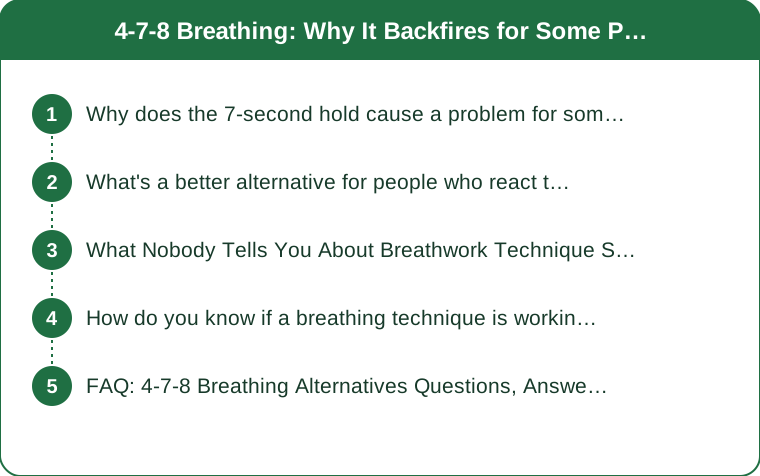
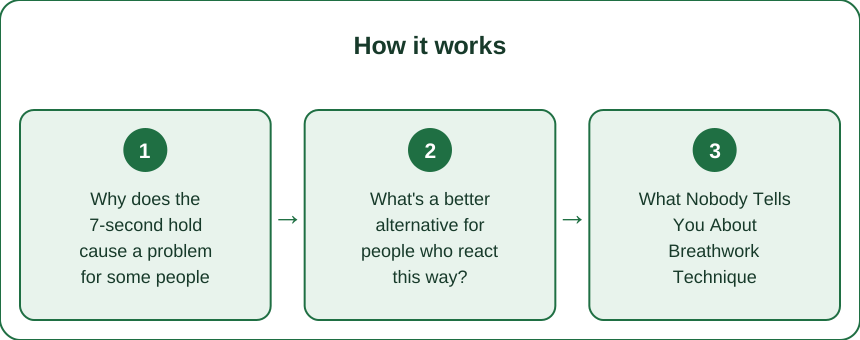
Why does the 7-second hold cause a problem for some people specifically?
For people with heightened sensitivity to bodily sensations (common in anxiety disorders), a held breath — even a voluntary, safe one — can trigger a mild air-hunger or restriction sensation that the nervous system interprets as a threat cue. This creates a stress response instead of a relaxation response, which is the opposite of the technique’s intent.
What’s a better alternative for people who react this way?
Extended exhale breathing (inhale for 4, exhale for 6-8, no hold) delivers a similar parasympathetic nervous system benefit — a longer exhale relative to inhale — without the breath-hold component that triggers air-hunger sensitivity. Box breathing (4-4-4-4, equal counts, shorter hold) is another option, since the hold is much shorter than 4-7-8’s 7-second hold.

What Nobody Tells You About Breathwork Technique Selection
No single breathwork technique works universally, despite how they’re often marketed. Nervous system response to breath-holding, in particular, varies meaningfully between individuals, and a technique that works well for one person can genuinely worsen symptoms for another — this isn’t a matter of doing the technique wrong, it’s a real physiological difference.
How do you know if a breathing technique is working against you rather than for you?
If a technique consistently leaves you feeling more alert, tense, or anxious rather than calmer after several honest attempts, that’s a legitimate signal to switch techniques rather than pushing through, assuming you’re doing it wrong. Trust the felt result over the technique’s general reputation.
FAQ: 4-7-8 Breathing Alternatives Questions, Answered
Is it normal for a calming technique to feel uncomfortable at first?
Some initial unfamiliarity is normal, but a technique that consistently increases distress across multiple honest attempts is different from normal first-try awkwardness.
Should I try shortening the hold in 4-7-8 instead of switching techniques entirely?
That’s a reasonable middle step — even reducing the hold to 3-4 seconds while keeping the rest of the pattern can reduce the air-hunger trigger for some people.
When should breathing-related anxiety symptoms prompt seeing a professional?
If breathwork consistently increases anxiety or triggers panic-like symptoms, a therapist familiar with anxiety and nervous system regulation can help identify what’s actually happening. This is general information, not medical advice.
TL;DR:
- The 7-second hold in 4-7-8 breathing can trigger air-hunger anxiety in sensitive people
- Extended exhale breathing or box breathing are lower-hold alternatives worth trying
- No breathwork technique works universally — individual nervous system response varies
- A technique that consistently increases distress is worth switching, not pushing through. This is general information, not medical advice.
Keep Reading
This article is for general informational purposes only and is not medical advice. Always consult a qualified health professional for guidance specific to you.